


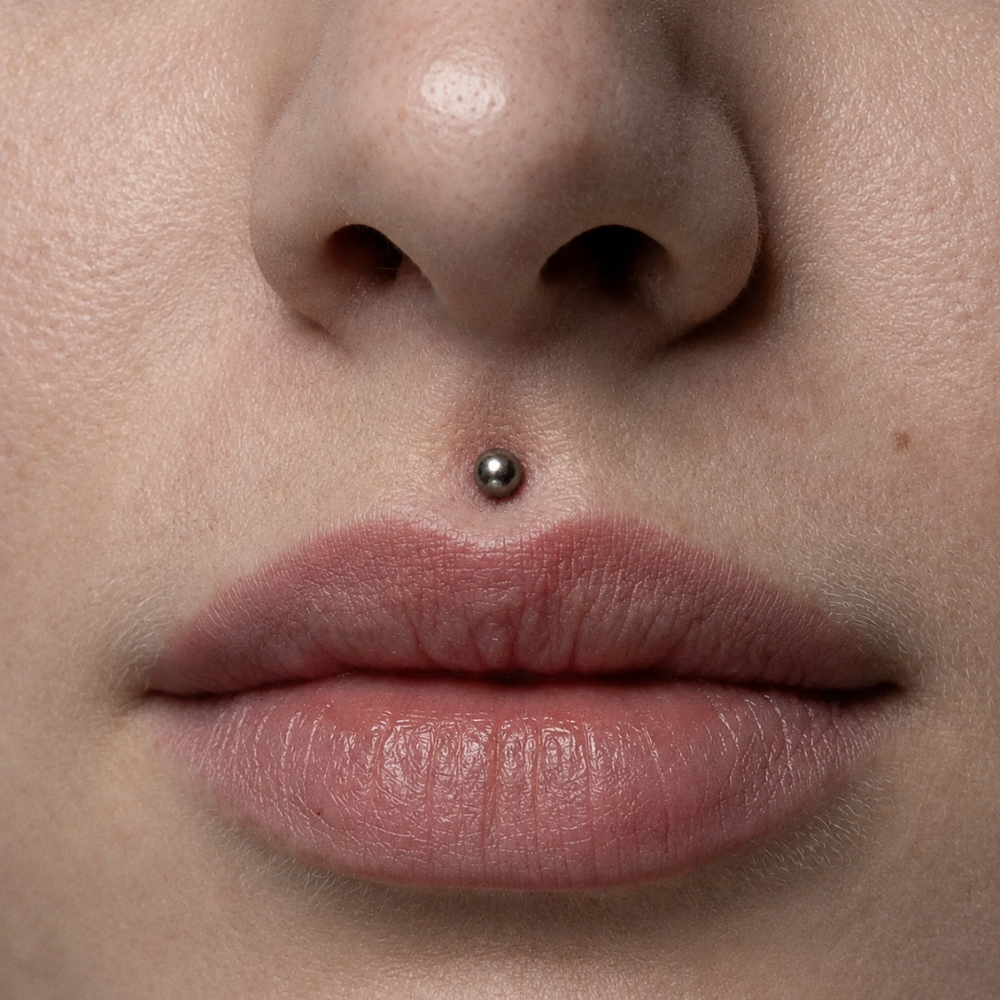
Medusa Piercing
Medusa (professionally called piercing Philtrum) is one of the most elegant and eye-catching types of facial piercings. Placed perfectly in the center, in the crease above the upper lip, it immediately gives the face incredible symmetry and emphasizes the Cupid's bow.
Regardless of whether you choose a subtle titanium ball or a flat disk with a shiny crystal, Medusa is a piercing that cannot be ignored. Due to its location in the oral cavity, it requires conscious care and the highest quality jewelry. W Piercing Planet We have prepared a complete guide for you that will help your Medusa heal perfectly.
What is Medusa Piercing?
The procedure involves horizontal piercing of the philtrum. The needle goes from the outside of the skin straight into the inside of the mouth, exiting just above the upper teeth.
Anatomy and frenulum: The most important task of the piercer before performing this procedure is to assess the inside of your mouth. This is exactly where the frenum of the upper lip is located (a small fold of mucous membrane connecting the lip with the gum). The piercer must perfectly measure the angle of the piercing so that the flat disc of the piercing rests smoothly on the mucous membrane, without damaging or pressing the frenulum!
Does a Medusa piercing hurt?
The tissue above the upper lip is densely innervated, which is why Medusa is considered to be slightly more noticeable than the classic Labret in the lower lip. Pain is most often assessed as: 4 to 5 on a 10-point scale.
The treatment itself takes only a second, but the real fun begins a few hours later:
- Huge swelling: The upper lip is an area that swells quickly and spectacularly. For the first few days you will be the owner of the so-called "duck beak" (effect of a strongly enlarged upper lip).
- Long rod: Due to this swelling, the piercer must fit you with an unnaturally long earring, which will initially protrude significantly and interfere with speaking. This is a transitional stage and absolutely necessary for safety!
Healing time and care Medusa
Medusa, like other piercings around the mouth, heals in two different environments: externally on the skin and internally on moist mucosa.
- The initial stage of healing (swelling goes down): from 2 to 4 weeks.
- Complete healing of the canal: from 3 to 4 months.
The most important rules:
- Rinsing is essential: After each meal, drinking anything other than water, and after smoking a cigarette, rinse your mouth with non-alcoholic dental mouthwash or sage infusion. Liquid alcohol will quickly burn away young, healing tissue.
- Be careful with food: For the first weeks, avoid eating apples, large sandwiches and anything that requires you to open your mouth wide. Be careful not to catch your upper teeth on the long bar of the earring! Give up very spicy and hot foods.
- Brushing your teeth: Be extremely careful when brushing your upper front teeth.
- No makeup from the outside: Absolutely avoid applying foundations, powders and concealers in the immediate area of the piercing. Cosmetics are the main cause of wound channel blockage and painful infections.
How to care for a fresh piercing? (Principles of care)
- Don't touch: Avoid touching the earring with dirty hands and refrain from "spinning" it.
- Cleanse regularly: Wash the piercing site 2-3 times a day with sterile saline solution.
- Avoid chemicals: Avoid using hydrogen peroxide, alcohol or antibiotic ointment. They may irritate the wound and delay healing.
- Be careful with your hair and clothes: Make sure that shampoo or conditioner does not remain on the ear after bathing. Be careful when putting on sweaters!
What jewelry for Medusa piercing?
W Piercing Planet We focus on the full awareness of our customers. If you decide on an earring that is in constant contact with your mucous membrane, gums and teeth, you must know that the material it is made of is the most important decision.
During healing:
Piercer uses a straight Labret with a flat disc at the back.
- Titanium is the only right choice: We want to make our customers aware that Surgical Titanium (G23) it is the safest material for piercing. Unlike cheaper alloys (e.g. surgical steel), titanium does not rust in the moist environment of the mouth, does not release harmful nickel and is 100% biocompatible. This is a guarantee of no allergic reactions and much faster healing.
- Rod Thickness: Most often 1.2 mm.
- Starting Length: Usually from 10 mm to even 12 mm, due to the massive swelling of the upper lip.
Downsize (Shortening the bar) – Save your teeth!
Neglecting to replace the earring with a shorter one is the biggest sin of Medusa owners. When the swelling disappears (after about 3-4 weeks), the long titanium rod will begin to rest against the upper teeth and gums during each conversation. This will lead to painful recession (slipping) of the gums and damage to the enamel. Go to the studio for a downsize - replacing the rod with a perfectly fitting one (usually 6 mm, 7 mm or 8 mm).
Check out our titanium jewelry


- Titanium
- Internal Thread
Titanium Labret with Ball - with Internal Thread
Choose your option


- Titanium
- Internal Thread
Titanium Decorative Labret - Diamond


Choose your option


- Titanium
- Internal Thread
Titanium Decorative Labret - Flat Cubic Zirconia
Choose your option


- Titanium
- Clicker
Titanium Segment Clicker with Cubic Zirconias Rim - Circle
Choose your option


- Titanium
- External Thread
Titanium Labret with Ball - with External Thread

Choose your option


- 316L steel
- Clicker
Steel Segment Clicker with Zircons - Circle
Choose your option


- Titanium
- Internal Thread
Titanium Decorative Labret - Three Cubic Zirconia Leaves


Choose your option
Medusa Piercing - Questions and Stories
Does Medusa (Philtrum) damage upper teeth and gums?
Does Medusa (Philtrum) damage upper teeth and gums?
There is such a risk, but a fully aware piercing owner can eliminate it. Damage to the gums and teeth occurs only when, after the swelling subsides, you do not change the earring to a shorter one (no downsize) or when you compulsively "play" with the earring, biting it and pushing it out with your tongue. A well-fitting, short labret naturally blends into the soft mucosa of the upper lip (phenomenon nesting), not having direct contact with the teeth while speaking.
Can a ring be fitted to Medusa?
Can a ring be fitted to Medusa?
No, hoop jewelry is not worn with a Medusa piercing. Due to its central position and distance from the edge of the lip, the circle would have to have a comically gigantic diameter, and its curvature in a straight canal would induce immediate migration (rejection). At Medusa, only straight labrets with a flat back and a decorative cap on the outside are worn.
I have a white ring around the disc inside my mouth - is it an ingrowth?
I have a white ring around the disc inside my mouth - is it an ingrowth?
If the flat disk on the back of the piercing creates a delicate, whitish indentation in the mucosa, but there is no pain, pulsation or excessive swelling around it, this is a completely natural process called "nesting". The body insulates metal from teeth with soft tissue. However, if the lips are swollen so much that the skin completely closes over the flat disc, "devouring it", this is an ingrowth (embedding) - in such a situation, you must immediately go to a piercer to replace the rod with a longer one.


