


Snug Piercing
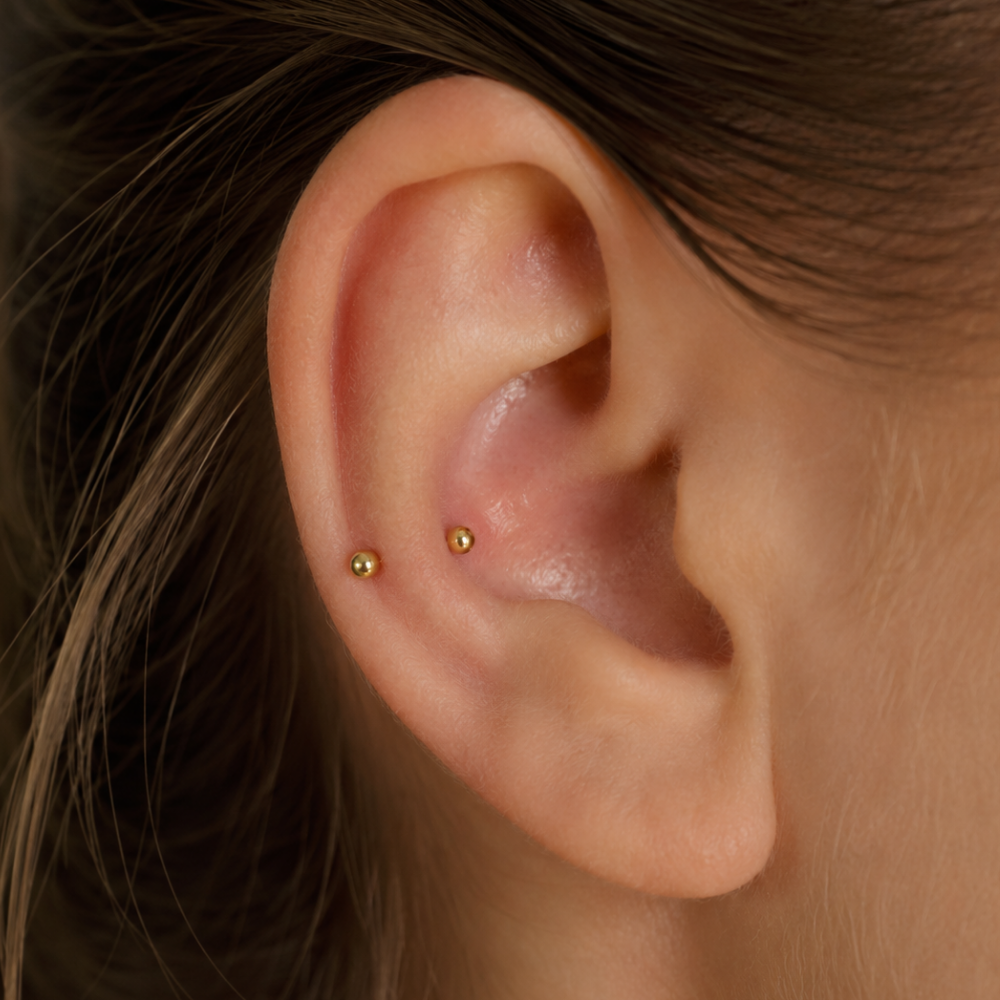
Snug, located in the middle of the ear, is undoubtedly one of the most unique and desirable piercings. It passes horizontally through a convex fold of cartilage (dike), creating an amazing effect - only decorative balls are visible on both sides, without the flat discs characteristic of labrets.
Despite its charm, Snug is legendary as "the most difficult ear piercing". It requires perfect anatomy, extensive experience of the piercer and iron discipline in healing. W Piercing Planet We have prepared a compendium of knowledge for you that will help you make an informed decision about this phenomenal piercing.
What is Snug Piercing?
Snug (often also referred to as Anti-Helix piercing) is a transverse piercing of the ear canal, i.e. the vertical fold of cartilage located between the shell (Conch) and the outer edge (Helix).
Anatomy in this case is to be or not to be. For the piercing to have a chance to heal, the cartilage fold must be very clearly defined, convex and relatively thin. If your dike is thick, flat or hides under the edge of the ear, making a classic Snug is impossible, and trying to do it will result in massive migration and scarring.
Does a Snug piercing hurt?
The needle must penetrate the cartilage through and through, passing through a hard and tight fold of tissue. For this reason, Snug is considered one of the most painful ear piercings.
Pain is most often assessed as: 6 to 7 on a 10-point scale. As with Rook, the sting is accompanied by very strong pressure and a loud "crunch". Immediately after the procedure, the ear becomes very red, hot and may pulsate for up to several days.
Snug healing time and care
Earlobe healing is a relatively short and hassle-free process as long as you follow basic hygiene rules.
- Initial healing time: 6 to 8 weeks.
- Complete healing of the canal: up to 3 months.
The healing of this piercing is a real test of patience. The cartilage of the cartilage is a place of great natural tension, which causes it to react with rapid swelling to every, even the smallest, change.
- The initial stage of healing (swelling goes down): from 4 to even 8 months.
- Complete healing of the canal: from 9 to over 12 months.
The most important rules for survival with the new Snug:
- Extreme swelling: Be prepared for your ear to swell up twice or even triple. The piercer will initially put on a very long earring, but in the case of Snug, the so-called up-sizes, i.e. visits to replace the barbell with an even longer one in the first weeks.
- Gentle hygiene: This area is difficult to clean thoroughly. Use sterile saline and dust-free cotton swabs, without tugging at the jewelry, twice a day.
- Total prohibition of pressure during sleep: In the case of Snug, even one night accidentally sleeping on a pierced ear can cause a rapid return of swelling and massive granulation tissue.
Get a good night's sleep and save healing!
Snug does not forgive oppression. To ensure that the regeneration process runs smoothly, we offer our own, specialized solutions donut-shaped piercing pillows. The ear safely "falls" into the hole in the center, completely relieving the cartilage.
How to care for a fresh piercing? (Principles of care)
- Don't touch: Avoid touching the earring with dirty hands and refrain from "spinning" it.
- Cleanse regularly: Wash the piercing site 2-3 times a day with sterile saline solution.
- Avoid chemicals: Avoid using hydrogen peroxide, alcohol or antibiotic ointment. They may irritate the wound and delay healing.
- Be careful with your hair and clothes: Make sure that shampoo or conditioner does not remain on the ear after bathing. Be careful when putting on sweaters!
What jewelry for Snug piercing?
During healing:
The gold standard is the bent barbell, i.e Banana (Curved Barbell) made of hypoallergenic material. Due to the rapid reactions of the tissue, it is crucial to use the highest quality materials without admixtures of nickel.
- Material: Surgical Titanium (Grade 23) only. At Piercing Planet, we care about the highest standards, which is why our titanium has independent laboratory certificates confirming its composition.
- Rod Thickness: 1.2 mm (or 1.6 mm for a more massive anatomy, which provides greater stability).
- Starting Length: Typically 10mm to 12mm due to the massive swelling.
Downsize: As soon as you notice that the swelling has gone down and a piece of the rod is sticking out of the ear, immediately go to the studio to have the earring shortened (usually to about 6 mm or 8 mm). A hooked, long banana will ruin the existing healing!
Decorative Jewelry for Snug Piercing


- Titanium
- Internal Thread
Titanium Labret with Ball - Internally Threaded
Choose your option


- Titanium
- Internal Thread
Titanium Decorative Labret - Diamond


Choose your option


- Titanium
- Internal Thread
Titanium Decorative Labret - Flat Cubic Zirconia
Choose your option


- Titanium
- Clicker
Titanium Segmented Clicker With Cubic Zirconias Rim - Circle
Choose your option


- Titanium
- External Thread
Titanium Labret With Ball - External Thread

Choose your option


- Titanium
- Internal Thread
Titanium Banana with Balls - Internally Threaded
Choose your option


- 316L steel
- Clicker
Steel Segment Clicker With Zircons - Circle
Choose your option
Snug Piercing - Questions and Stories
What is Faux Snug?
What is Faux Snug?
Faux Snug (pron. fo snag) is an excellent alternative for people who do not have the appropriate anatomy for classic Snug or are afraid of drastically difficult healing. It involves making two separate piercings - one Concha and one Flat (or Helix) piercing opposite it. When viewed from the front, this gives the optical illusion of one piercing through the labret, but the healing of two separate labrets is much faster, safer and less painful.
When can I put a wheel on my Snug?
When can I put a wheel on my Snug?
Due to the specific location (wide, convex fold of cartilage), wearing a ring in Snug Piercing is usually very uncomfortable and rarely practiced for aesthetic reasons - the ring would have to be unnaturally wide to cover this part of the ear. The vast majority of people stay with banana jewelry forever, possibly replacing simple balls with caps of various shapes after full healing (over 12 months).
My Snug ear has swollen so much that the earring is "going into" the skin - what should I do?
My Snug ear has swollen so much that the earring is "going into" the skin - what should I do?
This is a very common phenomenon in this piercing, commonly called "embedding". If your ear has swollen to such an extent that the balls at the ends begin to press against the tissue and go under the skin, do not wait - go to your piercer immediately. It will be necessary to replace the rod with an even longer one (so-called up-size) to restore blood supply and prevent the jewelry from becoming ingrown.
I have a lump near my earring - what is it?
I have a lump near my earring - what is it?
A small "lump" is most often granulation tissue, which is caused by mechanical irritation (e.g. sleeping on the ear, getting caught in clothes) or a wrong angle of the piercing. Don't squeeze it! Consult your piercer and follow appropriate saline care.


