


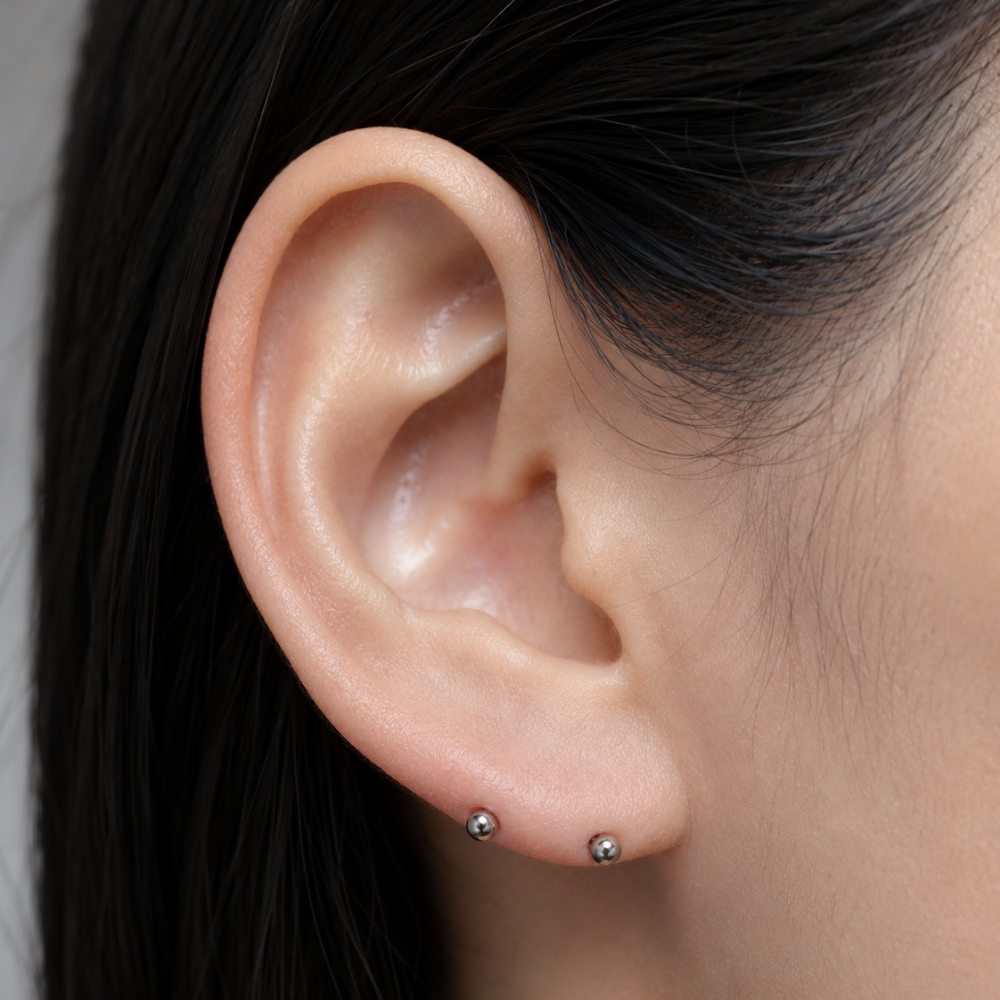
Transverse Lobe Piercing
Transverse Lobe, i.e. transverse (horizontal) earlobe piercing, is an option for people who are looking for something absolutely unique, but do not want to interfere with the cartilage. Instead of the standard piercing of the earlobe from front to back, in this case the needle passes through the tissue crosswise (from the edge near the cheek to the outer edge of the lobe).
Effect? Only two balls (or decorative caps) are visible, protruding from the bottom edge of your ear, giving the impression that they are floating in the air. W Piercing Planet we've put together a complete guide to this fascinating but challenging piercing.
How does Transverse Lobe differ from the classics?
This piercing technically behaves slightly differently than the standard Lobe. Due to its horizontal axis, it resembles more surface piercing (surface piercing) located on the earlobe.
Anatomy is the basis: Not everyone can afford the Transverse Lobe. The ideal candidate has large, fleshy and so-called "free" (not attached to the facial skin) earlobes. If the lobes are very thin or tight, it may not be possible to perform this piercing safely.
Does a Lobe piercing hurt?
Although we still operate only on soft tissue, without interfering with the cartilage, the pain may be slightly greater than with a classic ear piercing. It is usually rated at 2 to 3 on a 10-point scale.
This is due to the fact that the needle has to travel a much longer distance inside the tissue. For the same reason, experienced piercers most often perform this piercing by hand (the so-called method freehand), aiming precisely so that the piercing channel perfectly fits the natural curve of the lower edge of the ear.
Transverse Lobe healing time and care
Due to the fact that the piercing canal is very long, the healing process of Transverse Lobe takes much longer than traditional holes.
- Initial stage of healing: 2 to 3 months.
- Complete healing of the canal: from 4 to 10 months (depending on the thickness of the flap).
How to care for a fresh piercing? (Principles of care)
- Don't touch: Avoid touching the earring with dirty hands and refrain from "spinning" it.
- Cleanse regularly: Wash the piercing site 2-3 times a day with sterile saline solution.
- Avoid chemicals: Avoid using hydrogen peroxide, alcohol or antibiotic ointment. They may irritate the wound and delay healing.
- Be careful with your hair and clothes: Make sure that shampoo or conditioner does not remain on the ear after bathing. Be careful when putting on sweaters!
What jewelry to wear with Transverse Lobe?
The jewelry for this piercing is drastically different from that used in standard holes (you won't wear a classic labret here).
Initial and final jewelry
The only right and most convenient choice is bent barbell, i.e. the so-called Banana (Curved Barbell) made of the highest quality surgical titanium G23. Its delicate bend perfectly adapts to the natural, semi-circular shape of the earlobe, reducing tension inside the canal.
In rare cases (with specific anatomy), the piercer may choose a Straight Barbell.
- Rod Thickness: Most often 1.2 mm or 1.6 mm (a thicker rod provides better stability in a long canal).
- Length: Selected strictly to the width of your earlobe (always with enough allowance for initial swelling).
Decorative jewelry for Transverse Lobe


- Titanium
- Internal Thread
Titanium Labret with Ball - Internally Threaded
Choose your option


- Titanium
- Internal Thread
Titanium Decorative Labret - Diamond


Choose your option


- Titanium
- Internal Thread
Titanium Decorative Labret - Flat Cubic Zirconia
Choose your option


- Titanium
- Clicker
Titanium Segmented Clicker With Cubic Zirconias Rim - Circle
Choose your option


- Titanium
- External Thread
Titanium Labret With Ball - External Thread

Choose your option


- 316L steel
- Clicker
Steel Segment Clicker With Zircons - Circle
Choose your option


- Titanium
- Internal Thread
Decorative Titanium Labret - With Cubic Zirconia
Choose your option
Transverse Lobe - Questions and Stories
Can I put a ring on the Transverse Lobe?
Can I put a ring on the Transverse Lobe?
NO. The design of this piercing (a long, horizontal channel inside the flap) makes it impossible and dangerous to put any ring there. Barbell-type jewelry (usually bent) is always worn.
Can Transverse Lobe migrate?
Can Transverse Lobe migrate?
Yes. Because this piercing is carried out just below the surface of the skin at the edge of the ear, it behaves similarly to surface piercings. Wearing jewelry that is too heavy, hooking it frequently, or sleeping on your side can cause your body to "push out" the earring. That's why proper care and sleeping on a special pillow with a hole are so important.
I have fused earlobes, can I have this piercing done?
I have fused earlobes, can I have this piercing done?
In the vast majority of cases, fused (adherent) earlobes disqualify from performing a Transverse Lobe because there is not adequate access to the lower edge of the ear to guide the needle from side to side. The final decision should always be made by a professional piercer after assessing the anatomy in the studio.
I have a lump near my earring - what is it?
I have a lump near my earring - what is it?
A small "lump" is most often granulation tissue, which is caused by mechanical irritation (e.g. sleeping on the ear, getting caught in clothes) or a wrong angle of the piercing. Don't squeeze it! Consult your piercer and follow appropriate saline care.


